
BANDF AD

More storage supply chain pain incoming: Oh no, not NOR too
Supply shortages from the AI datacenter boom have already impacted the DRAM and NAND markets. Now they're coming to NOR flash as well.
EEtimes reports that as demand for AI servers rises, so too does demand for the NOR flash in those servers. These and other products, like embedded application servers, use NOR flash to store boot code and firmware, metadata configurations, and other low-latency code, which can execute in place without needing to be copied to DRAM.
BANDF AD
Taiwan’s Commercial Times says there can now be up to 30 NOR devices in a GPU server rack, costing up to $600 per Nvidia GB200 NVL72 system, and is forecasting that this may reach $900 in a couple of years.
NOR and NAND flash store bits in cells in the same way but access cells differently.
NOR cells are connected in parallel. Each cell's drain connects directly to a bit line, and sources share a common line. This allows direct, random access to individual cells or small groups.
NAND cells, which are smaller, are connected in series (like a chain or string; a page). Only the ends of the string connect to bit lines/source lines, so access goes through the entire chain.
BANDF AD
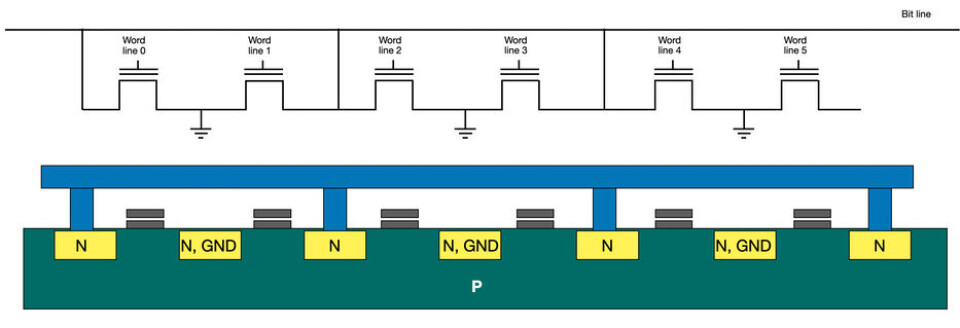
NAND accesses cells in pages, not individual bits. To read one NAND cell, the other cells in the string must be turned on and act as pass transistors. A NAND block contains many pages and is written in a single operation.

This results in different read and write performance. NOR flash has fast random reads but slower writes than NAND. NOR can also operate at higher temperatures than NAND, making it more suitable for some automotive and industrial applications.
Macronix, based in Taiwan, which makes both types of memory, is the main NOR supplier. President Lu Chih-yuan said there has been “strong demand for 2D NOR flash memory chips used in AI servers and high-performance-computing devices.”
Macronix is expanding its NAND fabrication capacity, in response to rising NAND demand, and this will delay the introduction of capacity-raising 3D NOR chips by two years.
BANDF AD
Winbond, which also makes both types of chips, aims to raise its NOR production capacity by 30 to 40 percent year-on-year. President James Chen said: “Our capacities have been fully booked this year and next year, including DRAM, NOR and NAND. The industry’s upcycle should last for quite a long time.”