
BANDF AD
Platters: WD new disk drive tech hits lucky 14
WD, currently shipping 11-platter disk drives, announced, new disk drive technology with up to 14 platters, enabling an up to 27 percent capacity increase.
The company announced this at its Innovation Day event earlier this month, along with high-bandwidth drives. dual-pivot drives, power-optimized drives, and more. We’re concentrating on the 14-platter angle here as it opens up the possibility of WD achieving increased drive capacity levels faster than Seagate, it’s main competitor.
BANDF AD
That’s because it will have a less demanding engineering job to increase areal density so as to reach new capacity levels than Seagate, as that company has 10-platter technology
A WD Ultrastar HC690 32 TB drive has 11 platters, each holding 2.91TB. A Seagate Exos M 32 drive has 10 x 3.2TB platters with its HAMR technology. (Toshiba has demonstrated 12-platter technology but it is shipping 10-platter drives.)
WD matches Seagate’s capacity despite having less advanced ePMR recording technology compared to Seagate’s HAMR with its higher areal density. Seagate has to push its data recording technology further than WD because it has less surface area in its disk drives on which to record data; 10 platters instead of 11.
Were WD to produce an 14-platter drive with its existing ePMR technology then it would deliver a drive with 14 x 2.91 TB; 40.7 TB, giving it a substantial 21 percent capacity advantage. It is predicting that it will, in fact, deliver 40 TB drives this year, with ePMR and HAMR variants. A 44 TB HAMR drive will follow later this year, with 60 TB ePMR and HAMR drives in 2028 and 100 TB HAMR drives in 2029, at which point its ePMR tech will run out of roadway.
BANDF AD
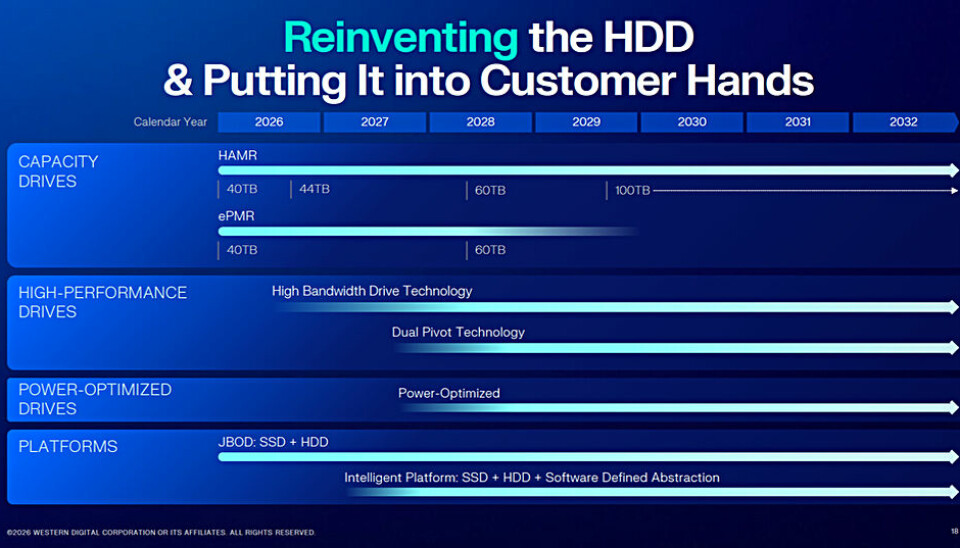
The 40 and 44 TB drives will have 11 x 4 TB platters while the 100 TB product is set to have 14 x 7.14 TB platters. Without the platter count increase WD would need to achieve a 9.1 TB/platter areal density level, pushing its media recording, read/write head positioning and signal writing and detection technology, and drive controller error detection and other firmware far harder.
Competitor Seagate has said it will introduce a 100 TB drive by 2030. At its current 10-platter level that means having 10 TB platters, with almost 3 TB more per platter than WD. At its Innovation Day WD said it will have reached the 10 TB areal density level through new and thinner laser tech in 2028. Chief Product Officer Ahmed Shibab said this is: “one of the reason’s I’m confident about 100 TB HAMR drives by 2029.”
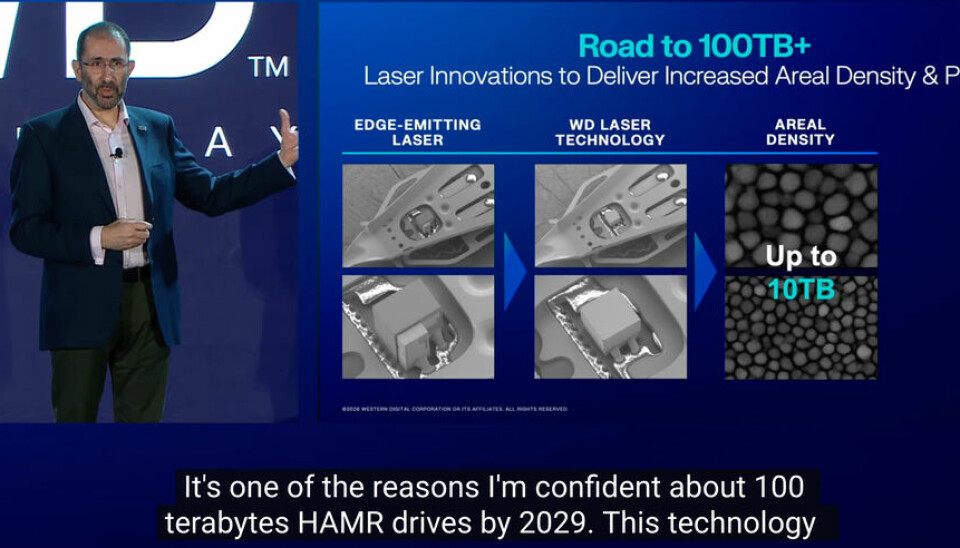
Thinner read/write heads take up less space, enabling more platters to be packed into the standard 35-inch disk drive enclosure. And 14 x 10TB platters suggest WD could produce a 144 TB drives, as Shihab mentioned in his presentation.
Put another way, by moving up from 11 to 14 platters WD needs to increase its current areal density by 155 percent. Seagate has to increase its areal density 213 percent. That means bit areas and track widths on the platters will be smaller, giving it more difficult development work in the recording medium, read/write head positioning, signal writing and reading, and controller firmware areas. WD has more headroom in these areas because of its platter count advantage.
BANDF AD
We think Seagate may increase its platter count. Although having only 10 platters keeps its cost of goods (COGs) down, lower than WD’s, the concomitant need to push its disk technology significantly harder, may over ride this and force a move to increases its platter count.
Our understanding is that it's possible Seagate could match WD’s coming high-bandwidth technology by evolving its existing Mach2 actuator tech. The dual-pivot technology could also arrive. Both of these things would increase bandwidth but not capacity.
And mass-capacity drive customers want more capacity. We have asked Seagate for a briefing on its roadmap to see if our platter count increase supposition is correct.